





[ad_1]
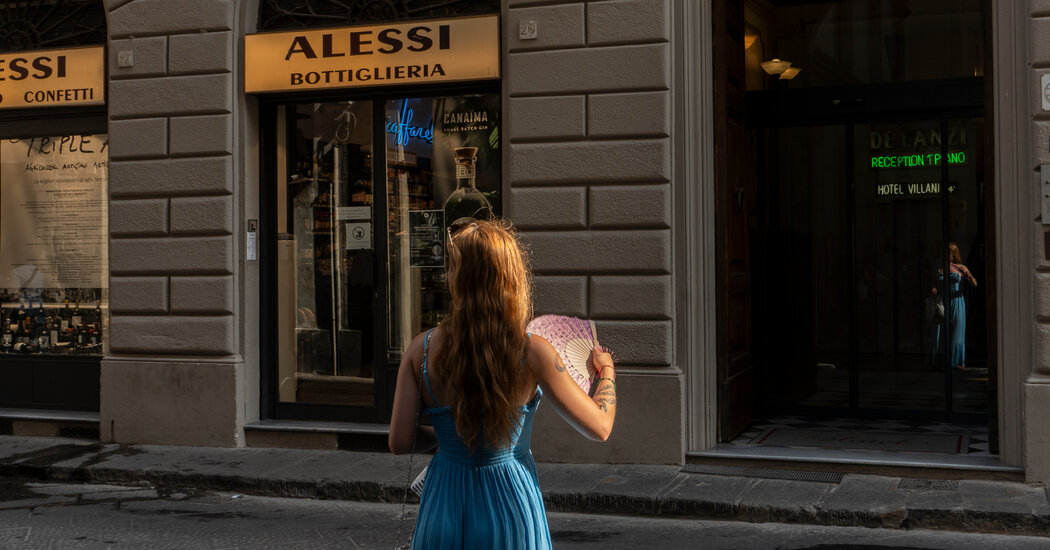
Tourists lined up for shade and held up umbrellas in front of Florence’s majestic cathedral this week. Street vendors sell fans and straw hats. Locals splashed water in front of the fountain, seeking respite from Europe’s latest heatwave.
“It felt like home,” said Alina Magrina, a 64-year-old tourist from California, a part of the state that, like much of the southern United States, has been hit by the heat. “But at home, we’d move from one air-conditioned place to another.” She said her chest ached from walking in the Florence sun, pausing on the Italian city’s iconic Ponte Vecchio bridge Bought an extra fan.
Severe heat is now the norm in summer in many parts of the world, not only in the United States, but especially in Europe, a continent where architecture and lifestyle remain virtually unchanged. Yet each year Europe appears to be particularly unprepared, even though it is warming faster than the global average.
Experts say European governments have largely ignored the warnings sounded nearly 20 years ago after a heatwave in 2003, the continent’s hottest year on record, killed an estimated 70,000 people. A report released this week attributed 61,000 deaths in Europe to last summer’s extreme heat.
Disaster may repeat itself this year. In some parts of southern Europe, heat waves started as early as May. The latest heatwave – known as a Cerberus, the multi-headed dog that guards the gates of hell – saw temperatures well above 37C this week in Florence, Rome and parts of Sardinia and Sicily , which is close to 99 degrees Fahrenheit.
Another bout of high temperatures is expected in the coming days, part of a heatwave caused by an African anticyclone, with highs of 48C (118F) or higher.
Since the scorching summer of 2003, European governments have developed national adaptation strategies and regularly issued heat warnings and guidelines to residents. But they have also been falling short of carbon emissions targets aimed at mitigating climate change and failing to invest in tangible solutions.
“Unfortunately, Europe has not really used the last 20 years to take the necessary action to restructure cities,” said Benjamin Coates, head of sustainability initiatives at the European Space Agency, which provides satellite imagery to policymakers. Can help governments plan for climate resilience.
“But we have to be fair,” he added. “It’s difficult because it requires long-term planning and a lot of investment.”
Part of the problem is that much of the burden falls on municipalities with limited resources and limited avenues to mitigate heat in sometimes ancient urban spaces that are valued and protected from drastic change .
Florence is a good example, as good as it is of the effects of rising temperatures, as well as adaptation efforts and their limits.
This summer, as it does every summer, Florence, the cradle of the Renaissance, is one of the hottest cities in Italy, nestled in the wide valley of the Arno that has historically facilitated trade. Last July, as the heat persisted, Italy’s health ministry estimated that the death toll in the north-central Italian city rose by 34%.
For nearly two decades, the city has struggled to adapt to a changing climate, revamping public offices, schools and hospitals, planting more trees and planning more parks in the suburbs. However, like all historic Italian cities, Florence has been working hard to make its centuries-old city center greener and cooler.
Sitting in his air-conditioned, frescoed office in the Palazzo Vecchio, Florence mayor Dario Nardella said “a lot has been done” since the early 2000s, but “There is more work to be done,” he added.
Mapped by the centrally located local university and the Northwest neighborhoods, Florence’s hottest areas share many common characteristics: there are few trees, and there’s a lot of cement.
Mr. Nadella explained that the city planted thousands of trees, invested nearly 1 billion euros ($1.12 billion) to keep cars from entering the city center and built two new streetcars that will The surrounding area is connected to the city center.
When the city’s first streetcar line was built in 2010, the management company even planted succulents between the tracks, following the principle that natural, permeable surfaces are cooler than asphalt.
Mr. Nadella showed renderings of a planned revamp of a downtown street in which asphalt will be replaced with Pietra Serena stone and will be flanked by orange trees. This is just one example, but making change in the historic center is difficult, he said.
“National laws protecting cultural heritage are an obstacle,” Mr Nadella said. “But so is our cultural identity and history. Our cities have been that way for centuries.”
Experts agree that the retrofit needed to ease the heat in European cities is daunting. “There are many action plans in Europe, but the scale of change needed to fully adapt to climate change is enormous,” said Rupp Singh, senior climate risk advisor at the Red Cross and Red Crescent Climate Centre.
At the city level, she explained, every building and home would need to be retrofitted to accommodate the very high temperatures. Authorities must provide shelter and health care to the poorer and more marginalized, and reduce the so-called urban heat island phenomenon, where temperatures are particularly high.
Ine Vandecasteele, an expert at the European Environment Agency, said urban adaptation experts generally agreed that a complete overhaul was needed in all sectors, “from buildings to transport to health, agriculture and productivity”.
Governments also need to engage all executive levels to address other risks associated with climate change, such as water scarcity and flooding. “Most countries are not yet aligned, but a lot of progress has been made,” she said.
Scientists in Florence and elsewhere in Italy are pushing for the introduction of cold pavement to reduce the temperature of asphalt and its ability to insulate. Los Angeles has dozens of miles of cold paved roads, a technique that is barely used in Italy.
“Reducing cement use in urban areas is not easy,” said lead researcher Marco Morabito of the Italian National Research Council in Florence, who has been studying urban heat islands since the 1990s. “But given global trends, there is a risk that buildings in the city center will face tough living conditions for an extended period of time.”
He explained that as residents in these areas deal with the scorching heat, the energy consumption of air conditioners will inevitably increase, and real estate may also lose value. “The economic impact is beyond what we can imagine today,” Mr Morabito said.
In a study published last year, Italy’s central bank noted that climate has an impact on real estate transactions, making buyers or tenants gravitate toward buildings that are more resilient to climate change and lowering the price of homes that cannot withstand extreme heat.
The challenge is not unique to Italy. Scientists believe that northern countries, even if they are less prone to heat, will have a harder time coping with heat because people are less acclimated to heat. In 2010, thousands of people were estimated to have died in a heat wave in Moscow.
Outside of Italy, Mediterranean countries such as Greece have already begun to consider coping strategies, but there, too, many of the efforts are localized. Greek authorities started using reflective pavements in the Greater Athens area, but the aftermath of the 2008 economic crisis prevented the project from being scaled up.
It took another decade for Athens to appoint a chief thermal officer to coordinate city-level responses to overheating.
Even countries along the Atlantic coast have taken smaller steps. In the Portuguese town of Cascais, near Lisbon, the municipality tried to create spaces for water to seep into the ground and planted native species better adapted to water scarcity along the streets.
In Paris, the government launched a plan to transform campuses into oases accessible to students and the local community, creating a series of shelters open to all. The mayor also pledged to secure the Seine ahead of the 2024 Olympic river competitions.
In Copenhagen, local officials are tearing down parking lots to stop drivers from pulling their cars into the city centre.
Experts recognize that some classic cooling strategies don’t work in historic cities. Customs such as mandating roofs painted white or installing heat-reflecting roofs in California are hard to imagine in a city like Florence, which has imposed restrictions on materials used to restore buildings in an effort to preserve the city’s historic character.
“Building materials such as cool pavements have advanced enormously over the past decade, but their use has No great progress has been made.” .
Reducing the amount of carbon Europe puts into the atmosphere would cost nearly $260 billion a year, while globally the annual cost of overheating would rise from $400 billion to as much as $1.3 trillion, he said. 2050.
“It’s also a horrible form of discrimination because the first victims of the heat are the poor,” Mr Santa Morris said. “Ninety percent of those who died in 2003 were low-income people.”
In the northern Italian city of Lodi, near Milan, a street worker collapsed this week while painting signs in temperatures exceeding 104 degrees Fahrenheit. He later died in hospital.